

In 2026, the ability to track people, assets, and vehicles indoors has moved from a “nice-to-have” to a business necessity. Global supply chains demand real-time visibility, automotive safety regulations require child presence detection, and smart factories need centimeter-level accuracy to prevent collisions. According to market research, the global indoor positioning and RTLS (Real-Time Location Systems) market is expected to exceed $90 billion by 2034, with UWB growing at a CAGR of over 19%.
Yet, there is no single technology that solves every indoor positioning challenge. Engineers, product managers, and system integrators must choose between UWB (Ultra-Wideband), BLE (Bluetooth Low Energy), and WiFi – each with distinct trade-offs in accuracy, power consumption, cost, and deployment complexity.
This guide provides a comprehensive, unbiased comparison based on 2026 standards, real-world case studies, and emerging trends. By the end, you will have a clear decision framework to select the right technology – or combination – for your project.
UWB transmits very short radio pulses across a wide bandwidth (≥500 MHz) at low power. It measures the Time of Flight (ToF) of these pulses between a tag and multiple anchors. By calculating the precise time difference (TDOA) or two-way ranging (DS-TWR), systems achieve centimeter-level accuracy. UWB’s wide bandwidth makes it inherently robust to multipath interference (signals bouncing off walls) and enables secure scrambling timestamp sequences (STS) to prevent spoofing.
Bluetooth Low Energy (BLE)
BLE estimates location primarily through Received Signal Strength Indication (RSSI) – the weaker the signal, the farther the device. Triangulation using three or more beacons gives room-level accuracy (typically 1–3 meters). Newer BLE 5.1+ features Angle of Arrival (AoA) and Angle of Departure (AoD), which improve accuracy to sub-meter levels in ideal conditions, but at a higher infrastructure cost. BLE’s key advantage is ultra-low power: a coin-cell tag can last for years.
Wi-Fi
WiFi positioning uses either RSSI fingerprinting (comparing signal strength to a pre-recorded map) or Fine Timing Measurement (FTM), which measures round-trip time. Because WiFi access points are already ubiquitous in warehouses, offices, and homes, the marginal cost can be very low. However, typical accuracy is 5–15 meters (room-level), and FTM consumes significantly more power than BLE, making it unsuitable for battery-operated tags.
The table below summarizes the key differences as of 2026. Values are representative of commercial off-the-shelf systems.
Parameter | UWB | BLE (5.1+ AoA) | WiFi (FTM) |
Accuracy (typical) | 10–30 cm | 1–3 m (RSSI), 0.5–1 m (AoA) | 5–15 m |
Maximum range (LOS) | 50–200 m | 50–100 m | 50–100 m |
Power consumption – active ranging | 10–20 mA | 5–10 mA (AoA) | 100–200 mA |
Power consumption – sleep | < 1 µA | < 1 µA | N/A (tags not typical) |
Tag battery life (1 min update) | 6–12 months (CR2032) | 2–5 years (CR2032) | Not feasible |
Infrastructure cost (per 1000 m²) | $2,000–$5,000 (anchors) | $500–$2,000 (beacons + gateways) | Low if existing APs |
Tag cost (OEM volumes) | $10–$25 | $2–$8 | $15–$30 (rare) |
Security / anti-spoofing | High (STS, IEEE 802.15.4z) | Low–Medium (can be encrypted) | Medium (FTM has some protection) |
Multipath immunity | Excellent | Poor–Medium | Medium |
Scalability (tags per area) | 100–500 (depends on update rate) | 1,000+ (low update rate) | Limited by AP density |
Latency (time to first fix) | 10–100 ms | 100–500 ms | 100–300 ms |
Smartphone support | Growing (iPhone 11+, some Android) | Ubiquitous | Ubiquitous |
Key takeaway: No technology wins in all categories. UWB excels in accuracy and security, BLE dominates low-power and cost, while WiFi leverages existing infrastructure for coarse location.
Pros:
Centimeter accuracy (10–30 cm) even in challenging environments.
Secure ranging with scrambled timestamps (STS) prevents relay attacks – mandatory for automotive digital keys.
High update rates (up to 100 Hz) for real-time tracking.
Works in NLOS (non-line-of-sight) with some accuracy degradation, still outperforms BLE.
Cons:
Higher tag power – active ranging consumes ~15 mA, limiting battery life if updated frequently.
Infrastructure cost – anchors are more expensive than BLE beacons.
Complex calibration – antenna delay must be calibrated for each design.
Pros:
Ultra-low power – years of battery life on a coin cell.
Very low tag cost – ideal for high-volume disposable or semi-disposable tracking.
Native smartphone support – every phone has BLE, no extra hardware.
Easy deployment – beacons are inexpensive, and many cloud-based RTLS platforms exist.
Cons:
Limited accuracy – even with AoA, real-world performance is often >1 m.
Sensitive to interference – Wi-Fi, microwave ovens, and human bodies affect RSSI.
Poor multipath handling – reflections cause large errors.
Security – easier to spoof than UWB.
Pros:
Leverages existing access points – zero infrastructure cost if you already have WiFi.
Room-level accuracy is sufficient for many logistics and people-counting applications.
No additional tags needed for employee tracking (uses phones or badges with WiFi).
Cons:
High power consumption – not suitable for battery-operated tags.
Poor accuracy compared to UWB.
Update rate limited – typical FTM implementations support only a few tags per AP.
Privacy concerns – WiFi tracking often requires opt-in.
In practice, the most successful indoor positioning systems do not rely on a single technology. They combine BLE for low-power wake-up and coarse location with UWB for on-demand centimeter-level ranging. This combo architecture solves the fundamental trade-off between accuracy and battery life.
How it works:
1. A BLE+UWB module (like the MS01SF1 module based on nRF52833 + DW3120) sleeps most of the time, consuming < 1 µA.
2. When an event occurs (motion detected by the accelerometer, or a BLE wake-up beacon is received), the BLE radio wakes the UWB transceiver.
3. UWB performs one or more high-accuracy ranging exchanges with nearby anchors.
4. The distance data is sent back via BLE or UWB to a gateway.
Real-world examples:
Automotive digital key (CCC standard): The phone (BLE) wakes the car’s UWB module when in proximity. UWB then performs secure ranging to verify the phone is inside a specific zone (e.g., driver door). No continuous UWB listening – battery drain is negligible.
Industrial asset tracking: A pallet tag uses BLE to advertise its presence every few seconds (very low power). When it enters a zone with a UWB anchor, the anchor triggers a UWB ranging session to get a precise location for forklift collision avoidance.
Smart home presence detection: BLE detects “someone is in the room”, then UWB measures exactly where that person is to adjust lighting or HVAC.
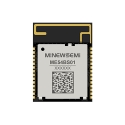
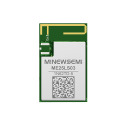
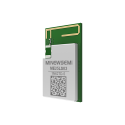
The MS01SF1 (nRF52833 + DW3120) is a reference implementation of this combo philosophy. It combines a powerful Nordic BLE SoC with a Decawave DW3120 UWB transceiver, offering all necessary interfaces (SPI, I2C, UART, GPIO) for custom applications.
Learn more about the MS01SF1 BLE+UWB combo module
Requirement: < 30 cm accuracy, low latency (< 50 ms), robust to metal shelves and moving machinery.
Recommendation: UWB or BLE+UWB combo. Pure BLE is too inaccurate; WiFi lacks real-time performance.
Example: A warehouse deploys UWB anchors on ceiling; each forklift carries a UWB tag. When a forklift approaches a pedestrian zone, the system triggers an audible warning. combo BLE+UWB tags on pallets report coarse position via BLE and only use UWB when entering high risk zones, extending battery life to 2+ years.
Requirement: Long battery life (months), room-level accuracy, low tag cost.
Recommendation: BLE. UWB is overkill and too expensive for hundreds of badges.
Example: A refinery issues BLE badges to workers. If a worker does not move for 10 minutes, an alert is sent. During evacuation, managers see which rooms still have occupants (accuracy 3–5 m is sufficient).
Requirement: High security (spoof-proof), sub-10 cm accuracy, low power (car battery not an issue, but key fob battery is).
Recommendation: UWB mandatory for digital key (CCC standard). For child presence detection (CPD), UWB radar mode (no tag needed) is emerging.
Example: Euro NCAP 2026 mandates CPD for top safety ratings. UWB radar can detect micro-movements of a sleeping child even under a blanket, while UWB ranging authenticates the key fob.
Requirement: Absolute accuracy of 5–10 cm for docking, but also a high update rate (100 Hz).
Recommendation: UWB for docking stations, BLE for coarse navigation, or fusion with visual odometry.
Example: An AGV uses UWB to precisely align with a charging station (2 cm accuracy). While traveling, it relies on BLE beacons for lane-level positioning (30 cm), saving power.
Requirement: Compatibility with visitors’ smartphones, low infrastructure cost.
Recommendation: BLE beacons (iBeacon / Eddystone). WiFi as a fallback.
Example: A museum installs BLE beacons near exhibits. The visitor’s phone receives push notifications when they approach. Accuracy of 1–2 m is more than enough.
Requirement: Medium accuracy (1 m), long battery life, low tag cost for hundreds of infusion pumps.
Recommendation: BLE for most equipment, UWB only for high-value assets that need instant location.
Example: A hospital tags wheelchairs with BLE. Nurses use a dashboard to find the nearest wheelchair. For defibrillators, UWB tags provide exact aisle and bay.
Use this flowchart (text version) to guide your selection:
Step 1 – Do you need < 50 cm accuracy?
Yes → Go to Step 2.
No → Go to Step 3.
Step 2 – Is tag battery life a primary constraint ( > 1 year on coin cell)?
Yes → Use BLE+UWB combo (BLE wakes UWB on demand).
No → Use pure UWB (e.g., automotive key fob, AGV).
Step 3 – Does your tag need to run for > 1 year on a coin cell?
Yes → Use BLE (RSSI or AoA).
No → Go to Step 4.
Step 4 – Do you already have dense WiFi APs (every 15 m)?
Yes → Use WiFi FTM for room-level tracking (no extra infrastructure).
No → Use BLE (cost-effective beacons).
Step 5 – Is security / anti-spoofing critical?
Yes → Must include UWB (STS protection). BLE and WiFi alone are insufficient.
Primary application | Recommended technology | Why |
High-accuracy asset tracking (industrial) | UWB or BLE+UWB combo | Accuracy 10–30 cm, robust to metal |
Personnel safety (low accuracy needed) | BLE | Low cost, long battery life |
Automotive digital key | UWB + BLE (combo) | Mandated by CCC, secure ranging |
Child presence detection | UWB radar | Only technology that detects micro-movements |
Warehouse AGV docking | UWB | Sub-10 cm absolute accuracy |
Smart building wayfinding | BLE beacons | Smartphone compatibility, low cost |
Healthcare equipment tracking | BLE (high volume) / UWB (critical assets) | Balance of cost and accuracy |
Expected to be ratified in 2026, 802.15.4ab introduces multi-millisecond ranging (MMS) to extend UWB’s range and narrowband auxiliary radio (NBA) to reduce power consumption during synchronization. Existing modules like the DW3120 may support some features via firmware updates. This will make UWB even more competitive for low-power, long-range applications.
UWB is evolving from pure ranging to integrated sensing and communication (ISAC). A single UWB module can now detect gestures, breathing, and presence without a tag. Automotive child presence detection (CPD) and foot-kick trunk openers are already commercial. In 2026, we expect UWB radar to enter smart home devices for fall detection and sleep monitoring.
The FiRa consortium launched its first Plugfest in April 2026, bringing together members like Qualcomm, STMicroelectronics, and NXP to test real-world interoperability. FiRa certification will become as important as Bluetooth SIG qualification for UWB products. Selecting a module that follows FiRa’s PHY and MAC specifications reduces integration risk.
Future indoor positioning will fuse UWB, BLE, IMU (accelerometer/gyroscope), and even cameras using edge AI. For example, a warehouse tag could use BLE to detect if it is near a known anchor, then trigger UWB for precision, while IMU fills gaps when UWB is blocked. Lightweight neural networks on nRF52833 (Cortex-M4) make this feasible.
Q1: Can UWB replace BLE?
No. UWB is not designed for low-power continuous broadcasting. BLE remains superior for low-data-rate, long-battery-life applications. The two technologies are complementary.
Q2: Is UWB safe for continuous use around people?
Yes. UWB operates at very low power spectral density (below the noise floor of most other devices). It is FCC and ETSI-certified for unlicensed use.
Q3: How much does a UWB tag cost vs a BLE tag?
In OEM quantities (10k+), a BLE tag can cost $2–4, while a UWB tag costs $10–20. The gap is narrowing as UWB volumes increase.
Q4: Do I need line-of-sight for UWB?
No, UWB works through walls and obstacles, but accuracy degrades (e.g., from 10 cm to 30-50 cm). BLE would suffer much more.
Q5: Which smartphones support UWB today?
Apple: all iPhone 11 and later. Google: Pixel 6 Pro, 7 Pro, 8 Pro, 9 Pro. Samsung: Galaxy S23 Ultra, S24 Ultra, and some Note models. Android UWB API is mature.
Q6: How do I calibrate antenna delay for UWB modules?
Antenna delay calibration is essential for accuracy. A simple method: place two modules at a known distance (e.g., 2 m), adjust the tx_antenna_delay parameter until the reported distance matches the real distance. Our MS01SF1 comes pre-calibrated, but you may need to fine-tune for custom enclosures.
Choosing between UWB, BLE, and WiFi for indoor positioning is not about finding the “best” technology – it is about finding the right fit for your accuracy, power, cost, and deployment constraints.
Use UWB when you need centimeter-level accuracy, high security, and can accept a higher tag cost.
Use BLE when you need years of battery life, very low tag cost, and room-level accuracy is sufficient.
Use WiFi when you have existing dense APs and only need coarse presence.
Use BLE+UWB combo when you want the best of both worlds: long battery life with on-demand high accuracy.
The MS01SF1 (nRF52833 + DW3120) is a production-ready combo module that implements the combo BLE+UWB architecture. It is ideal for prototyping and mass production of RTLS tags, automotive sensors, and consumer tracking devices.
About the MinewSemi
MinewSemi is an Innovative IoT Module Expert integrating product research and development, embedded electronic engineering and manufacturing, and service support. We offer high-performance wireless connectivity modules and solutions based on Bluetooth LE, GNSS, LoRa, WiFi, UWB, mmWave Radar, and etc.











 Store
Store