

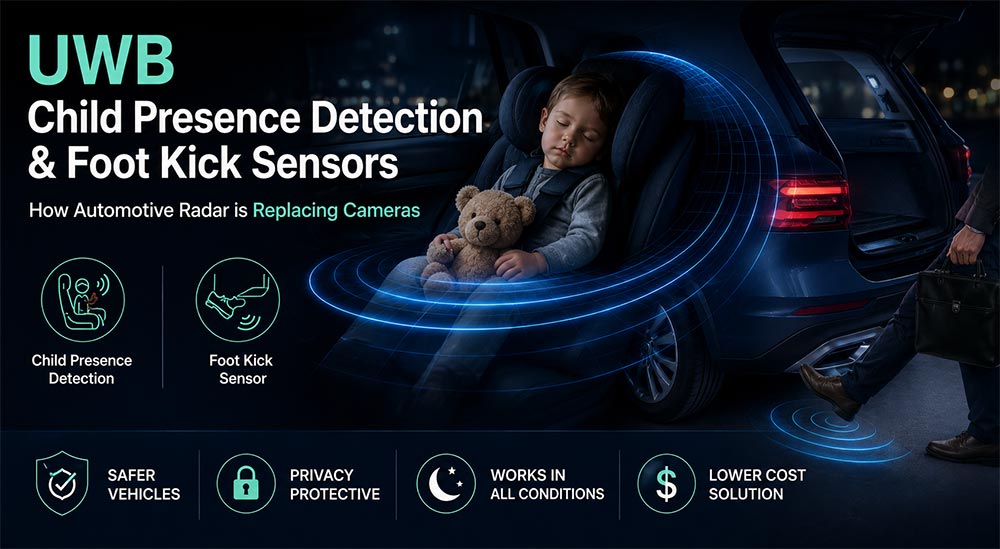
Between 1990 and 2023, over 1,000 children in the United States died from pediatric vehicular heatstroke—deaths that were almost entirely preventable with basic detection technology [1]. That grim statistic finally triggered a global regulatory response.
On the other side of the car, drivers have long wrestled with trunk release sensors that fail in rain or trigger when a dog walks by. Traditional solutions—capacitive sensors that fail in extreme temperatures, infrared that gets blinded by sunlight, 77GHz mmWave that works beautifully but costs a fortune—all came with trade-offs.
Enter UWB radar. The same ultra-wideband chip that certified your digital key entry can now double as a child presence detection (CPD) radar and a kick-to-open trunk sensor. One hardware platform. Multiple safety and convenience use cases. Dramatically lower system cost.
This shift is not hypothetical. In 2025, Chinese automaker Zeekr became one of Asia's first to deploy UWB-based CPD and kick-sensing in production vehicles using NXP's Trimension NCJ29D6A—the industry's first single chip combining secure ranging, short-range radar, and an integrated MCU. [3] In 2026, Euro NCAP finalized requirements that effectively mandate CPD in any vehicle seeking a top safety rating. [11]
This article explains why UWB radar is replacing cameras and legacy sensors, what the new regulations require, and how engineers can get started with UWB-based automotive sensing.
Understanding today's UWB automotive market requires starting with regulation. Euro NCAP's 2026 protocol makes Child Presence Detection mandatory for vehicles seeking top safety scores. The updates are specific and technically demanding.
Euro NCAP 2026 has a clear mandate: CPD systems must confirm a child's presence using direct detection methods—movement, breathing, or heartbeat. Rear-seat reminders that infer risk based on whether a door was opened (indirect detection) no longer count toward CPD points. [2] Cameras work but struggle in darkness or when covered by blankets. UWB radar sees through seats and blankets, detecting micro-movements from respiration without privacy concerns associated with interior cameras.
Systems must detect children up to six years old across all seating positions, footwells, and the driver's seat (luggage area excluded). The system must function across optional and removable seating rows and be default ON at the start of every trip.
On timing: In locked vehicles, a warning must begin within 15 seconds of child detection. In unlocked vehicles, within 10 minutes. Initial alerts must be noticeable from outside the vehicle (beeping or flashing lights lasting at least three seconds). If ignored, the system must escalate. These timing requirements demand fast sensing and classification—not a task mmWave radar was designed for, but exactly where purpose-built UWB radar excels.
CPD now contributes up to five points under the Occupant Monitoring category. In a system where every point matters for a five-star rating, automakers cannot afford to treat CPD as optional. The global impact extends beyond Europe—C-NCAP (China) has similar requirements, and both NHTSA and other regulators are closely watching.
UWB for CPD operates differently from UWB for ranging. While digital key ranging measures time-of-flight between a tag and anchor, UWB radar analyzes reflected signals bouncing off people inside the cabin. The radar detects micro-Doppler signatures from chest movements (breathing) and micro-motions (children shifting positions), performing occupancy mapping to locate occupants without needing physical tags.
This works regardless of lighting, works through blankets and child seats, and—crucially for privacy regulations—captures only signal reflections, not identifying imagery.
At MWC Barcelona 2026, ARIA Sensing and Algorized unveiled a CPD system built around the Hydrogen 4×4 UWB Radar SoC. Key specs: true 3D detection, integrated digital beamforming delivering approximately 5° angular resolution, up to 1.8GHz programmable bandwidth, and ultra-low power architecture running AI workloads directly on the chip. [4]
"Our Hydrogen chip was engineered from the ground up for radar performance," says Alessio Ciaccatori, CEO of ARIA SENSING. "Traditional UWB solutions were never optimized for high-resolution radar sensing. When combined with Algorized's edge-native AI, the platform detects micro-motions, respiratory activity, occupancy mapping, and behavioral patterns—significantly reducing latency at a fraction of the power consumption and cost of traditional radar architectures."
Parameter | UWB Radar | In-Cabin Camera | mmWave Radar (77GHz) | Capacitive/Infrared |
Works through blankets/seats | Yes | No (visual blocked) | Yes | No |
Privacy compliant | Yes (non-imaging) | No | Yes | N/A |
Detects breathing | Yes (micro-Doppler) | Limited | Yes | No |
Single-chip covers CPD + ranging | Yes | No | No | No |
Works in darkness | Yes | No | Yes | Limited |
Cost (per vehicle) | $ | $$ | $$$ | $ |
The market trajectory confirms this is not a niche technology. According to MarketIntelo, the global UWB-based child presence detection market was valued at $312 million in 2024 and is forecast to reach $1.15 billion by 2033—a robust CAGR of 15.7%. [5]
QYResearch projects the China market alone to reach approximately 5.58 billion RMB (about $770 million) by 2031. [6]
Another analys is placed the global in−cabin safety UWB positioning market at 348 million in 2024, forecast to hit $1.67 billion by 2033. [7]
These figures do not include kick-sensing and other convenience applications, which are largely additive using the same hardware.
For automakers, the real economic case for UWB radar comes from hardware reuse. The same UWB anchors and modules installed for CPD can also enable kick-to-open trunks, eliminating separate sensor systems.
Legacy kick-sensing technologies each had major flaws:
Infrared sensors suffered from environmental light interference
Capacitive sensors degraded in extreme temperatures and humidity
Ultrasonic performed poorly in rain and snow
77GHz mmWave worked reliably but carried high system cost
UWB solves all these problems simultaneously. According to Calterah, whose Dubhe UWB SoC series powers kick-sensing applications, UWB delivers centimeter-level action recognition accuracy, low power consumption, and multi-scenario adaptability—all at significantly lower cost than mmWave alternatives. [8] Key advantages:
Hardware reuse: The same UWB anchor enabling digital key can serve as the kick-sensing radar receiver—no additional hardware required.
Robust interference rejection: Even with motion resembling foot kicks (rolling objects, pedestrians passing by), the high angular resolution prevents false triggers.
Real-world reliability: Yuanfeng Technology reported that their UWB radar kick-sensing solution achieves >99.9% kick detection success rate, response time <300ms, and approximately 0% false trigger rate in testing that included water splashes, pets moving through the sensing area, and pedestrians passing by. [10]
Zeekr's 9X flagship SUV uses NXP's Trimension NCJ29D6A for CPD and kick-sensing, making it one of Asia's first production vehicles to deploy UWB across both use cases. This same platform also handles passive keyless entry and secure digital key functions. Meanwhile, embedUR Systems developed an edge AI solution on the same NXP platform that enables trunk opening via hand or foot gestures, processing gestures in real-time on an optimized 215KB AI model while maintaining power efficiency. [9]
Once UWB radar is in the vehicle, the same sensors can be used for multiple additional applications:
Application | How UWB Radar Delivers Value |
Intruder alert | Detects unauthorized entry through broken windows or unlocked doors, not just door-status sensors |
Seatbelt reminder | Occupancy mapping identifies exactly which seats are occupied—including rear-facing child seats often missed by weight sensors |
Sleeping driver detection | Head-nodding and micro-motions picked up by cabin radar, triggering driver alerts |
Smart HVAC | Occupancy positions guide directional air flow, saving energy |
This capability stacking means the economics improve with each added use case. Initial CPD deployment serves safety regulation compliance; adding kick-sensing, seatbelt reminders, intrusion detection, and HVAC zoning comes largely through software and algorithm development, not additional hardware.
Throughout this article, the focus has been on UWB radar capabilities. But real-world automotive systems require both UWB and BLE working together.
How BLE fits into automotive UWB systems:
Function | BLE Role | UWB Role |
Digital key | Low-power proximity detection (wakes system when phone approaches) | Secure ranging to determine precise location (driver door vs. passenger side) |
CPD & kick-sensing | Configures UWB radar parameters, reports detection status to cloud/TCU | Performs actual radar sensing and micro-motion detection |
OTA updates and diagnostics | Handles low-bandwidth telemetry (radar health status, configuration sync) | Handles high-bandwidth firmware updates through application processor |
Zeekr's implementation pairs Trimension NCJ29D6A with NXP's KW45 Bluetooth LE chip. The BLE core handles key fob and smartphone discovery and low-power wake-up; the UWB core performs ranging for door access and radar sensing for CPD and kick functions. This dual-radio architecture is becoming the industry standard for next-generation automotive access and safety systems.
For engineers building UWB-based automotive sensing applications, here are practical starting points:
NXP Trimension NCJ29D6A development board: For production-bound automotive projects. Fully integrated secure ranging + radar, with AUTOSAR compatibility and built-in MCU.
Calterah Dubhe evaluation kit: Supports more advanced radar configurations (1T4R and 2T4R channels). Especially suited for kick-sensing and rich occupancy mapping use cases.
Qorvo DW3000-based evaluation platforms: Widely available for prototyping general UWB ranging and basic radar applications before moving to automotive-specific hardware.
For CPD, the core challenge is distinguishing between occupant motion, environmental clutter (vibrations, air circulation), and actual child presence. Machine learning approaches:
Feature extraction: Raw UWB radar returns → Doppler spectrum analysis → motion vs. breathing classification
Edge AI constraints: Automotive radar models must run within tight memory footprints (often under 500KB RAM)
Sensor fusion: Combine UWB radar with accelerometer data to filter out vehicle motion artifacts
For kick-sensing, key metrics include detection latency (target <300ms), false rejection rate (target <0.1%), and false positive rate (near zero in real-world conditions). Calterah's Dubhe achieves 14° angular resolution with 2T4R beamforming—sufficient to distinguish foot gestures from rolling objects or animals passing at ground level.
Timeline | Event | Impact on UWB Radar |
2026 | Euro NCAP 2026 enforcement begins | Mass adoption across European and Asia-Pacific markets. CPD becomes baseline expectation for OEMs. |
2026-2027 | IEEE 802.15.4ab certification ramps | New standard introduces multi-millisecond ranging (MMS) and narrowband-assisted radio (NBA) for extended range and reduced power. Existing UWB hardware may support features via firmware updates. |
2027-2028 | Next-gen UWB chips with integrated AI accelerators | Single-chip solutions with dedicated neural processing units for real-time radar classification. Edge AI model sizes continue to shrink through quantization and model compression techniques (embedUR's implementation already runs on 215KB models). |
2030 | Ubiquitous UWB across all vehicle segments | From luxury to mass-market, UWB becomes as common as backup cameras. Industry forecasts suggest 40% of vehicles shipped globally will incorporate UWB technology. |
A: Yes. Euro NCAP 2026 requires direct detection of children left in the cabin for any vehicle seeking a 5-star safety rating. UWB radar is the only single-chip solution that meets both detection and privacy requirements.
A: Yes. NXP's Trimension NCJ29D6A and similar automotive UWB SoCs combine secure ranging for digital keys with short-range radar for CPD and kick-sensing on the same hardware.
A: UWB radar detects micro-Doppler signatures from chest movements as small as 1-2 mm. It can reliably detect breathing through blankets, child seats, and in complete darkness with >99% accuracy in production systems.
A: UWB radar typically costs 5−10 per vehicle while 77 GHz mmWave costs 20-40. UWB also reuses digital key hardware, further lowering effective cost when both features are deployed.
A: Yes. Unlike infrared or capacitive sensors, UWB radar is unaffected by water, dirt, or extreme temperatures. Production systems report >99.9% success rates even in heavy rain.
A: The Zeekr 9X (2025) is among the first production vehicles with UWB-based CPD and kick-sensing using NXP's Trimension platform. Several 2027 models from European and Chinese OEMs are expected to follow.
A: UWB captures only radio reflections—not images. It can detect occupancy and breathing without identifying faces or recording video, making it compliant with strict privacy regulations like GDPR for in-cabin sensing.
A: Retrofitting is technically possible but not yet commercially available. Aftermarket UWB radar modules exist for prototyping, but production retrofit kits require vehicle integration for alerts and are expected after 2027.
A: UWB kick-sensing typically works within 20-50 cm of the rear bumper. Angular resolution of 5-14° prevents false triggers from passing pedestrians or rolling objects while accurately detecting foot gestures.
A: No. UWB operates at very low power (-41.3 dBm/MHz) across a wide bandwidth (≥500 MHz), making it naturally robust to narrowband interference from Wi-Fi, Bluetooth, or cellular signals.
UWB technology has quietly transitioned from a niche ranging protocol to a sensing platform that directly saves lives. The combination of Euro NCAP 2026 mandates, the economic case for hardware reuse across safety and convenience applications, and the emergence of purpose-built UWB radar SoCs positions UWB as the winning in-cabin sensing technology for the remainder of the decade.
For engineers and product managers planning next-generation vehicle systems, the message is clear:
If you are designing a new vehicle platform today, plan for UWB radar from the start. The regulatory clock is running.
If you are prototyping automotive sensing algorithms, start with evaluation kits from NXP, Calterah, or Qorvo before moving to production-grade automotive chips.
If you are sourcing components for production, look for UWB radar SoCs with AEC-Q100 qualification and ISO26262 ASIL readiness.
Sources:
Kids and Car Safety — "Child Hot Car Deaths Report 1990-2023", 2024 [1]
SmartEye — "What Euro NCAP 2026 Says About Child Presence Detection", 2025 [2]
NXP Semiconductors — "Trimension UWB Technology Enables Zeekr Child Presence Detection", 2025 [3]
ARIA Sensing & Algorized — MWC 2026 announcement, March 2026 [4]
MarketIntelo — "UWB-Based Child Presence Detection Market Report 2033" [5]
QYResearch — "China UWB Child Presence Detection Radar Market Report", 2025 6]
Microwaves & RF — "UWB Radar Addresses Automotive Child Presence Detection", March 2026 [7]
Calterah — Company news on Dubhe kick-sensing applications, September 2025 [8]
embedUR Systems — Autocar Professional, June 2025 [9]
Yuanfeng Technology — AutoHome, January 2025 [10]
Automotive World — "Euro NCAP announces 2026 protocol changes", November 2025 [11]









 Store
Store